



Most TRT clinics already have an EHR. That is important, but it is not the same thing as having a system that actually runs clinic operations. Once a practice starts dealing with intake speed, scheduling, reminders, follow-up, labs, pharmacy coordination, and recurring patient communication, the difference becomes obvious. The chart may be organized, but the workflow around it is still manual.
This is where a lot of growth stalls. The clinic is not struggling because it lacks a place to store records. It is struggling because people are carrying the handoffs between systems. That creates delays, missed follow-up, inconsistent patient communication, and more administrative work every time volume increases.
An EHR handles records, not operational flow
An EHR is meant to hold clinical documentation. It gives providers a place for notes, histories, medication details, and supporting records. That function matters, but it does not solve the operational side of a modern TRT clinic.
A true clinic workflow starts before a patient record is fully built. It starts when a prospect fills out a form, books a consult, asks a question, misses a reminder, needs lab follow-up, or reaches a refill point. If those steps happen in separate tools, the staff becomes the connection layer. That is not a software strategy. It is manual orchestration.
We outlined the cost of that fragmentation in our breakdown of what actually breaks when clinic tools are disconnected. Separate systems do not stay separate on paper. They collapse into someone’s daily workload.
Why workflow failures cost more than software gaps
Most clinics do not lose sleep over whether data can be stored. They lose sleep over dropped steps. A lead sits too long before outreach. A patient books a consult but never receives the right sequence of reminders. A follow-up does not happen on time because no one has a clear trigger to act. These are workflow failures, and they directly affect revenue, retention, and patient experience.
That is also why timing matters so much in telemedicine operations. In this article on lead-to-consult speed, we showed how delays reduce conversion before care even begins. A record system cannot fix that by itself. The clinic needs process control.
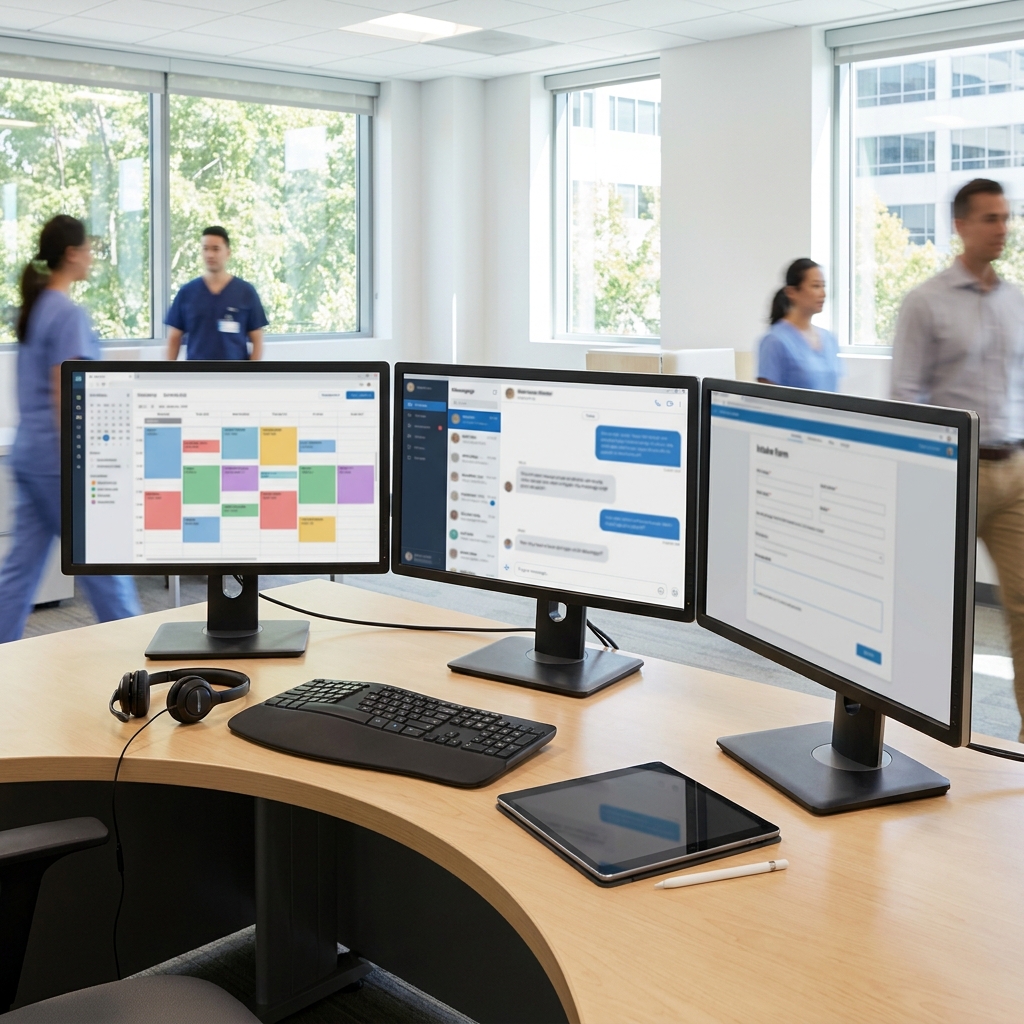
What a true practice management solution adds
A practice management solution connects the work between steps. It gives the clinic one operating layer for intake, scheduling, task routing, communication, and recurring follow-up. Instead of hoping staff remembers the next action, the system defines it.
For a TRT clinic, that means new leads can be routed into a structured intake flow. Consult scheduling can trigger the right reminders automatically. Missed appointments can surface for re-engagement instead of disappearing into a spreadsheet. Communication history can stay visible in the same operational view as scheduling and next actions. Fulfillment-related steps can move in sequence instead of relying on manual checklists.
That is what separates a charting environment from a true operating system for the clinic.
Why disconnected tools create hidden headcount pressure
Point solutions often look less expensive at first. The hidden cost shows up in labor. Every manual follow-up, copied field, status check, and reconciliation step is a tax on the team. A clinic may think it is saving money on software while quietly paying for the gaps through payroll and inconsistency.
That problem gets worse as volume rises. Growth does not just mean more patients. It means more chances for no-shows, stalled intake, missed communications, and broken handoffs. The clinics that grow cleanly usually do so because they reduce process friction early. That is the same principle behind scaling without adding equal headcount.

How to evaluate whether your current system is enough
Do not start with a feature checklist. Start with the patient journey. Ask how a new lead is handled from the first inquiry through consult, onboarding, recurring follow-up, and retention. Then ask where the process depends on a person noticing something instead of a system moving it forward.
If your team has to watch inboxes manually, send one-off reminders, piece together patient status from different apps, or remember which patients need the next touchpoint, the issue is not a lack of effort. It is a lack of operational structure. That is the gap a true practice management solution is meant to close.
If you want a simpler way to compare your current stack against a connected clinic workflow, explore Red Letter Nexus and look at how much of your day is still being held together by staff memory and manual handoffs.